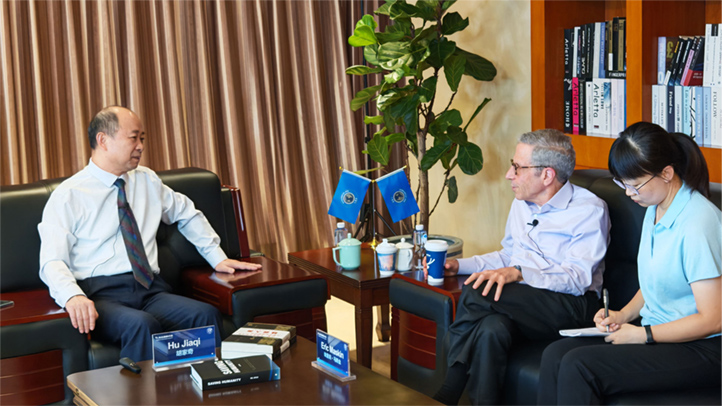
On June 15, 2026, Beijing witnessed an intellectual feast that transcended borders and disciplines. Mr. Hu Jiaqi, Chairman of Humanitas Ark, held an academic exchange with Professor Eric Maskin, the 2007 Nobel Laureate in Economics and a professor at Harvard University, under the theme “Technology and the Future of Humanity.” Through his consecutive meetings with Nobel laureates, Chairman Hu Jiaqi has drawn global attention to the issues of technological safety and the holistic survival of humanity.
Professor Maskin is one of the founding fathers of mechanism design theory, providing the foundational logic for market mechanism optimization and public policy design. For his groundbreaking work, which reshaped modern economics, he was awarded the Nobel Memorial Prize in Economic Sciences, offering vital theoretical support for the improvement of the modern economic system and sustainable global economic development.
Chairman Hu Jiaqi, an anthropologist with profound academic achievements, is the world’s earliest pioneer in systematically studying technological crises and a key architect of the theoretical framework on human technological risks. Since 1979, he has conducted systematic research on human issues, published several million words of scholarly monographs, and built a comprehensive academic system. Over the years, he has focused on the potential extinction risks hidden behind rapid technological development, and has promoted global awakening to technological safety through various channels. He has written twelve open letters to world leaders, with a total circulation exceeding one million copies. He founded Humanitas Ark, which has rallied over 14 million supporters from 255 countries and regions, harnessing collective strength to advance the cause of saving humanity.
During the exchange, Chairman Hu Jiaqi outlined his 47‑year journey of research on human issues, elaborated on his academic system, and systematically introduced his core methodology of “Extinction Path Analysis + Defense Limit Testing.” He also highlighted a major flaw in the mainstream scientific approach that uses probabilistic methods to assess the risk of technology‑induced human extinction, emphasizing that such methods essentially foster a “gambler’s mentality,” downplaying the severity of extreme risks and leading humanity to neglect potential existential threats.
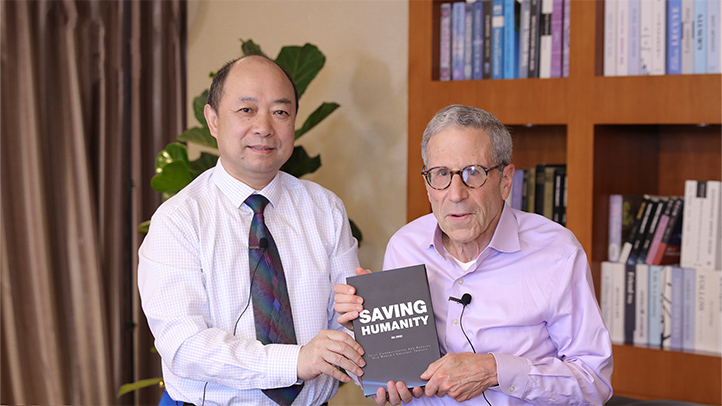
Professor Maskin was very interested in Mr. Hu Jiaqi's propositions. He listened attentively throughout, frequently asked questions, and spoke highly of Mr. Hu Jiaqi's perseverance and humanistic spirit. He fully agreed with Mr. Hu Jiaqi's analysis of human nature and expressed concern about the immense power inherent in science and technology. Professor Maskin noted that Mr. Hu Jiaqi's warning transcends the technological dimension and directly addresses the fundamental problems of human civilization, warranting deep reflection by the global academic community. Before parting, the professor graciously wrote:
“Dear Mr. Hu,
I think you are right that there is an urgent need to regulate powerful technologies — especially AI — to protect humanity from extinction. I would be happy to join with you in trying to make that happen.
Eric Maskin
June, 2026.”
After the meeting, both sides attended a luncheon where they continued to exchange views on technology governance and the future of humanity.
Since March of this year, Chairman Hu Jiaqi has held academic dialogues with Nobel Laureate in Chemistry Professor Michael Levitt, Nobel Laureate in Physics Professor Barry Barish, and Professor Sir Konstantin Novoselov. This meeting with Professor Maskin marks the fourth such dialogue within just a few months. This series of high‑level exchanges not only signals that the issue of technological development and the holistic survival of humanity is increasingly moving onto the international academic center stage, but also demonstrates that Chairman Hu Jiaqi is taking concrete actions to build a cross‑disciplinary, cross‑border global platform, pooling precious intellectual consensus and strength for the unified governance of technology and the sustainable future of human civilization.
